
Two far-right mobilisations on the south coast last weekend showed Danny Tommo attempting something rather different from the usual Tommy Robinson rally.
The numbers were not enormous. But in Dover on Saturday 5 September, Patriot Platform succeeded in secretly concentrating perhaps 150 to 200 activists at the port, many dressed in black and wearing balaclavas. The next evening Tommo helped turn the unexpected arrival of a refugee boat in Portsmouth into an emergency far-right mobilisation of more than 200 people.
The important development is not a sudden leap in far-right numbers. It is an attempt to create a smaller activist force that can be moved quickly, follow instructions and intervene at selected targets.
The balaclavas and matching black clothes were political theatre of a kind familiar to the history of the far right. They made a relatively small mobilisation look more formidable and created images designed for circulation across far-right social-media. But they were also an test of organisation—could people receive private instructions, arrive dressed as requested, keep the location quiet and carry out a common task?
That is where Richard Donnelly’s analysis is particularly useful. He warns against either swallowing Tommo’s grandiose claims or dismissing the whole affair as cosplay. Donnelly describes Patriot Platform as a “small, unstable and highly personalised formation”, and suggests judging it by its “direction rather than its inflated self-description”.
Tommo is trying to draw together a harder activist layer from the loose networks that have developed around Robinson demonstrations, asylum-hotel protests, flag campaigns and the dozens of local groups calling themselves South East Patriots, Kent Patriots and similar names. Donnelly’s insight is that this is partly an “adaptation born from weakness as well as strength”.
Tommo subsequently called Dover a “dummy run”. That description fits better than the more extravagant claims made beforehand about an unprecedented action that would change everything. They did not seize Dover. They did not stop Channel crossings. They disrupted road access for several hours and created a propaganda spectacle. But a dummy run implies another run.
Portsmouth exposed the contradictions
Portsmouth on Sunday 6 September was different. There had been no secretly prepared operation around Eastney comparable to Dover. At around 8pm the Home Office says more than 200 protesters were present. Many copied the black clothing and face coverings seen in Dover.
Tommo stood in the water broadcasting to his followers and declared, “Roads are all blocked, they are never going to be able to leave here.”
But they did leave. The protesters attempted to stop three coaches carrying the refugees from departing. Police imposed a dispersal order and used batons and PAVA spray during the confrontation. The coaches eventually moved away at about 4am.
There is a temptation to imagine that somebody is now sitting in a headquarters issuing orders to Britain’s far right. There is little evidence for that. What is developing is much more like a network. Robinson provides enormous reach. Tommo is attempting to organise part of the activist layer.
Reform wants the anger—but not Tommo controlling it
The fallout has also exposed tensions on the right. Nigel Farage condemned the masked Dover protesters, while other Reform figures sought to distinguish between the men in balaclavas and supposedly respectable public anger about immigration.Reform wants the reservoir of anti-migrant anger channelled into votes. Tommo wants to demonstrate that he controls an activist constituency that politicians cannot simply ignore. Restore Britain figures can position themselves further to Reform’s right and court activists whom Farage regards as politically embarrassing.
Racist rhetoric about Britain being “invaded” helps legitimise the premise upon which groups such as Patriot Platform operate—the idea that normal politics has failed and somebody therefore has to physically intervene.
The forthcoming Unity demos initiated by Stand Up To racism are vital, we should be pulling the widest possible forces into these mobilisations.
Local Actions
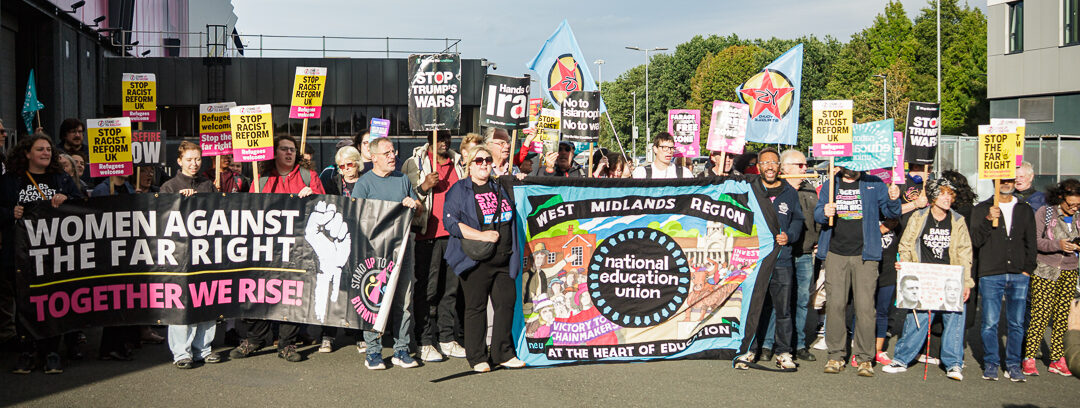
Away from the major confrontations on the south coast, far right and anti-migrant groups staged a series of mostly small protests across Britain over the weekend of 5–6 September. In Hull, Manchester, Middlesbrough, Leeds and Crowborough, the picture was uneven, but there was little sign of the kind of breakthrough that some of the right’s online propaganda would suggest.
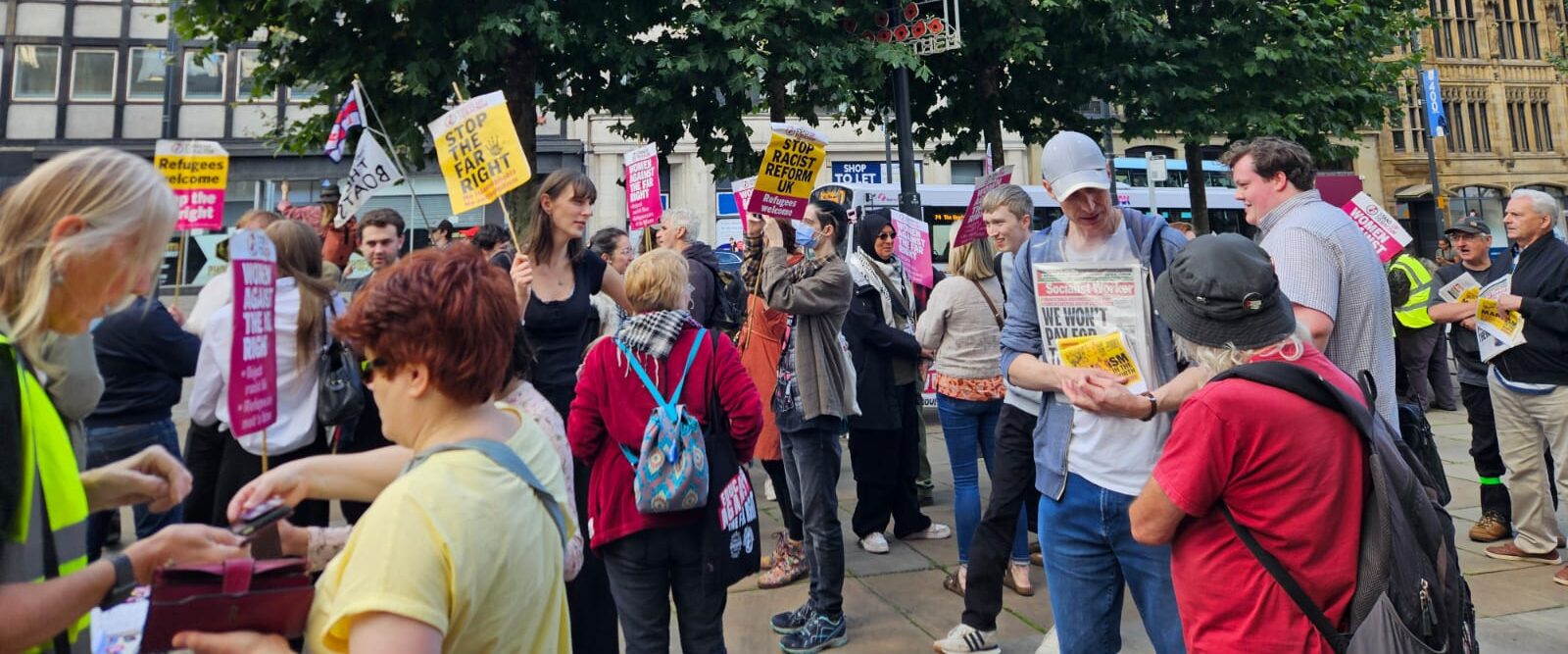
Far right demonstrators were opposed in Leeds, failed to appear at all in Crawley, and found themselves faced with a noisy anti-racist community event in Mumbles. In Bournemouth, 40 activists from political parties, unions, churches and community organisations met to plan the next stage of campaigning.
In Leeds, an anti-migrant mobilisation was met by Stand Up To Racism and other anti-racists. Local activists reported around 70 people initially on the anti-racist side, with numbers increasing as Palestine solidarity supporters joined them. The police kept far right YouTubers and livestreamers away from the anti-racist mobilisation, while the counter-protest maintained stalls and chanting through the day. Local activists estimating somewhere between roughly 70 and 100.

In Hull, around 30 to 40 far right joined the latest Hull Patriotic Protestors rally, organised by veteran anti-migrant activist John Gilling, also known online as John Francis.
About twenty five Hull and East Yorkshire SUTR supporters handed out 500 flyers on Saturday to leaflet the public about the upcoming Unity Rally coming up on September 26th, during Hull’s biggest annual Arts event, the Freedom Festival.
Despite objections, including from SUTR, Police insisted on facilitating a “ Stop the boats” so called anti extremism rally and March by Hull Patriotic Protesters on the main day of the festival, an annual event established nearly twenty years ago, to commemorate the anniversary of the Slavery emancipation Act. Street Performers from all over the world, artists and street acrobats entertain the crowds over the weekend all over the city. There is a lot of anger that at the very last minute, events in central Hull were cancelled or moved to facilitate a Hull Patriotic Protesters to rally and then march through the area with their flags, chanting anti migrant and transphobic slogans and attempting to intimidate passers by. Leafleters stood our ground as they passed, with people glad there was an anti racist presence in the face of such an appalling decision to give them the Square. “People are determined to renew efforts to build the Unity Rally in three weeks time”
In Manchester, former Britain First figure Ashlea Simon brought her breakaway All For England organisation into Piccadilly Gardens. Simon’s social-media accounts boasted that AFE had “stormed Piccadilly Gardens”, but there is no evidence that it represented any substantial mobilisation.
The group later moved to the government’s new Number 10 North offices, where its supporters displayed a crude banner attacking Greater Manchester mayor Andy Burnham. Police confiscated the banner and one masked All For England supporter was arrested. Searchlight described the mobilisation as modest and said Simon’s new organisation has so far failed to demonstrate that it represents much more than another small fragment of the far right.
That is worth noting because Simon’s split from Paul Golding’s Britain First has taken some existing activists with her. All For England can generate aggressive social-media content and provocative stunts, but Manchester offered little evidence that it can yet convert that into numbers.
A “patriot” protest also took place in Middlesbrough on Sunday..
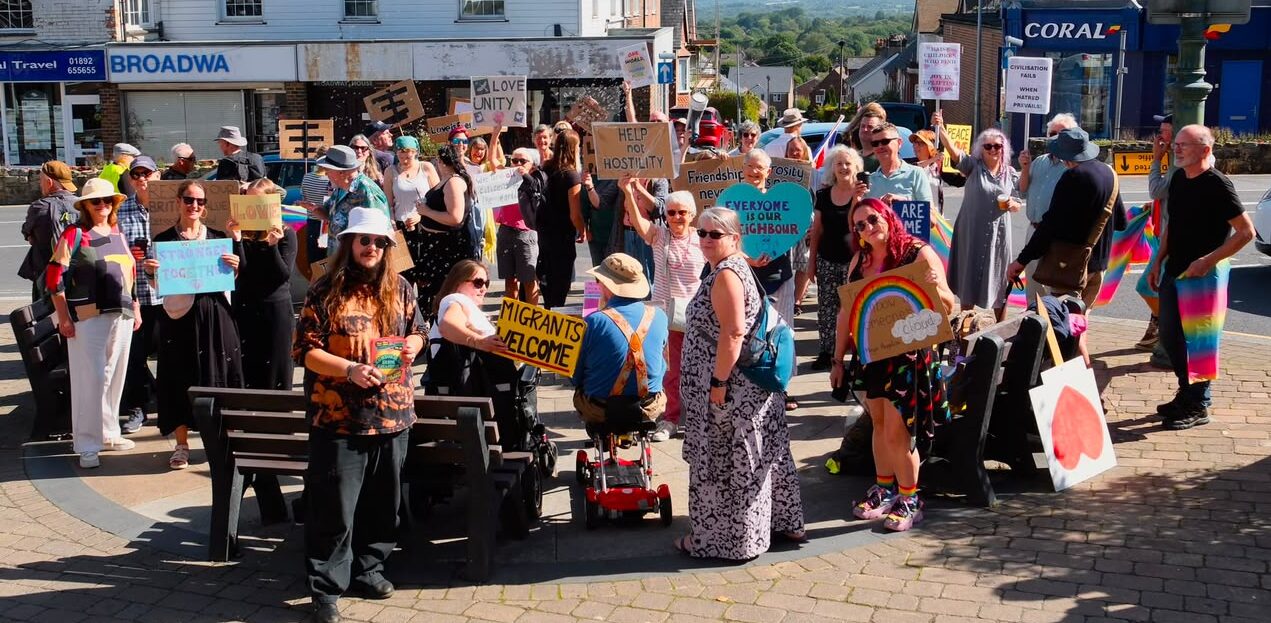
In Crowborough, the campaign against housing asylum seekers at the army training camp continued on Sunday. Crowborough Says No is still openly calling for protests even though the camp is now occupied, demanding that asylum seekers remain within its boundaries and urging supporters to continue mobilising. This remains one of the more persistent local anti-asylum campaigns. It has developed its own organisation, fundraising structures and online infrastructure, while far right livestreamers and nationalist networks amplify its protests nationally. Numbers have dwindled considerably though. Alongside it, anti-racists are maintaining weekly Sunday solidarity gatherings in Crowborough town centre.
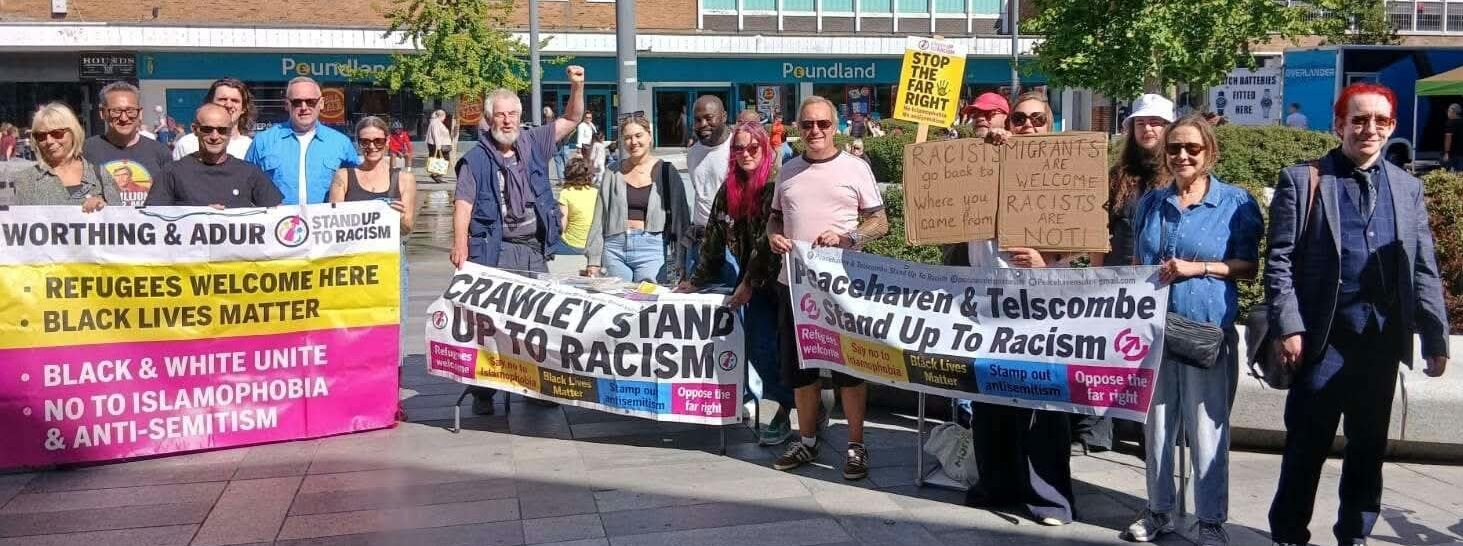
Elsewhere the far right failed even to get onto the streets. In Crawley, South East Patriots had advertised a march through local Facebook networks for Saturday. Stand Up To Racism activists from Crawley were joined by supporters from Brighton and Hove, Worthing, Peacehaven and Lewes in preparation for a counter-mobilisation. The South East Patriots did not appear. Anti-racists instead held a unity event in the town centre, running a stall, distributing leaflets and talking to local people. The possibility that some of the right’s activists had gone elsewhere cannot be excluded, but the immediate fact was straightforward—the advertised Crawley mobilisation failed to materialise. The counter had been publicly called in advance by Crawley SUTR after reports that South East Patriots intended to target the town.
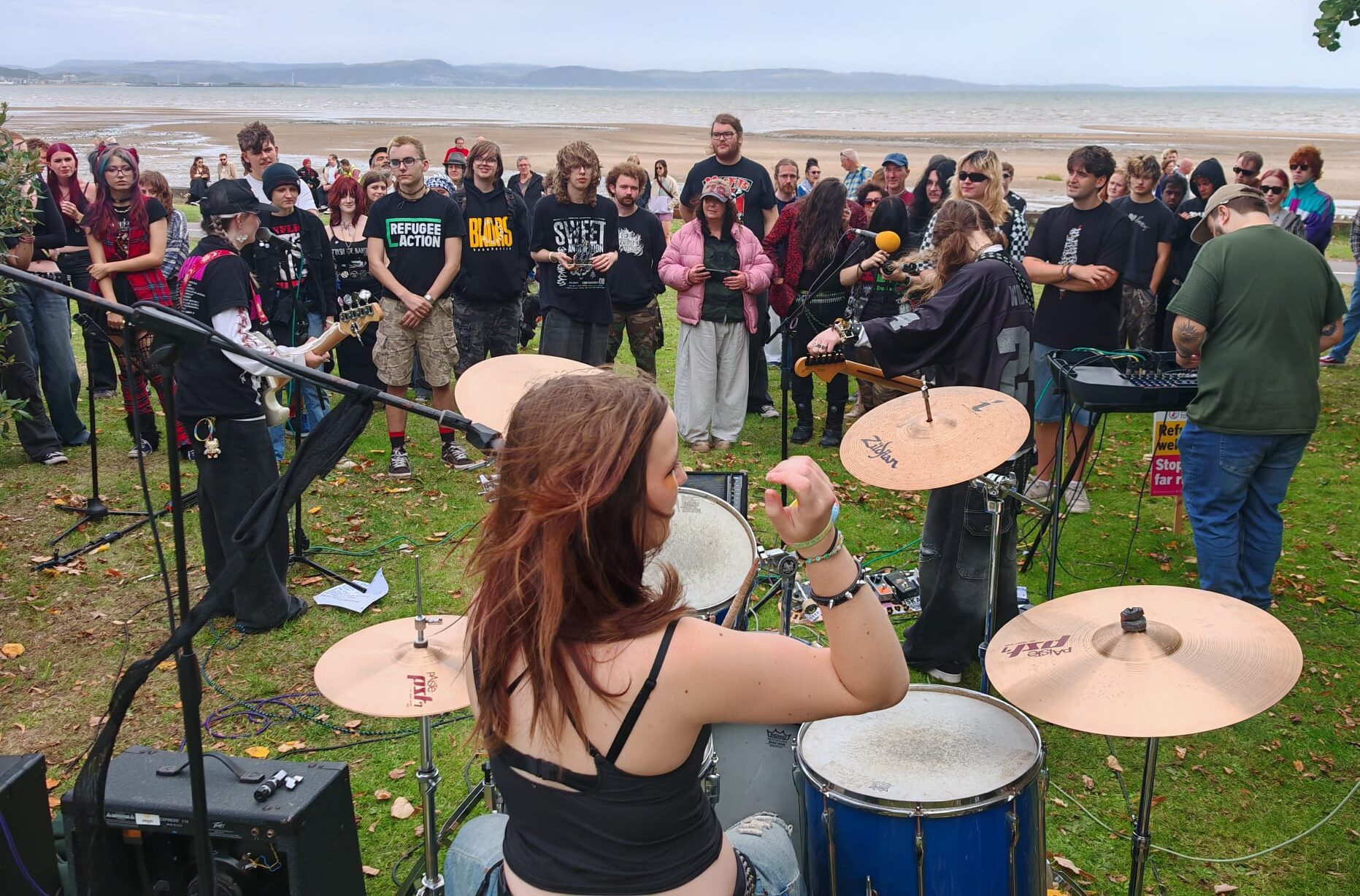
There was another example of how anti-racists can seize the initiative in Mumbles, near Swansea. Local organisations held a Love Skateboarding Hate Racism—Skate Against Hate event at Mumbles Skate Park after a racist incident involving a family leaving the park.
Plaid Cymru, Green Party and Your Party members joined Stand Up To Racism and Love Music Hate Racism, alongside Mumbles Skatepark Association, Mumbles Community Council, REPEAT Records and Swansea City of Sanctuary. After speeches from supporting organisations—including two members of the Senedd and a local councillor—bands played to a mixed crowd of young people, families and activists.
A small group of fascists appeared nearby apparently hoping to intimidate people at the event. They were instead driven away as the music and crowd continued. The organisers summed it up neatly: “Noise 1, Nazis 0.”
The importance of such activity is not simply defensive. It creates networks before the far right arrives. In Bournemouth, around 40 people attended an anti-racist organising meeting bringing together the Liberal Democrat leader of Bournemouth, Christchurch and Poole Council, Labour and Green members, representatives of the local race equality council, Catholic peace and justice activists and members of UNISON, UCU, NEU and CWU.
Workshops discussed fighting racism in workplaces, Women Against the Far Right, social media, elections and work through churches and charities. Activists are now building towards a Bournemouth Unity demonstration on 3 October, with particular attention on opposing Reform ahead of the full council elections next May.
Monitoring Group
Across much of Britain the organised far right remains fragmented, uneven and often quite small. Hull could muster only a few dozen and its organiser announced his retirement. Ashlea Simon’s supposedly dynamic new organisation produced another small Manchester stunt. The Middlesbrough action remains so limited that even its organisers are difficult to establish, while South East Patriots failed to appear in Crawley at all.
The right increasingly operates through overlapping local groups, national social-media networks, livestreamers and political amplification. A few dozen people on a street can produce video that is subsequently watched by tens of thousands, while racist rhetoric from Reform, Restore and sections of the mainstream right gives local agitators a much wider political environment in which to operate.
The answer is not to inflate every tiny racist gathering into an unstoppable movement, but neither is it to leave the streets to them. Hull’s leafleters, the Crawley mobilisation, the Leeds counter-protest, Skate Against Hate in Mumbles and the organising meeting in Bournemouth point towards another possibility—building the broad anti-racist networks that can confront the far right when it appears and organise against the racism that feeds it between demonstrations.
This combined with the long list of Unity demos that are in the offing indicates that the anti racist majority will win out.
Forthcoming Events


