
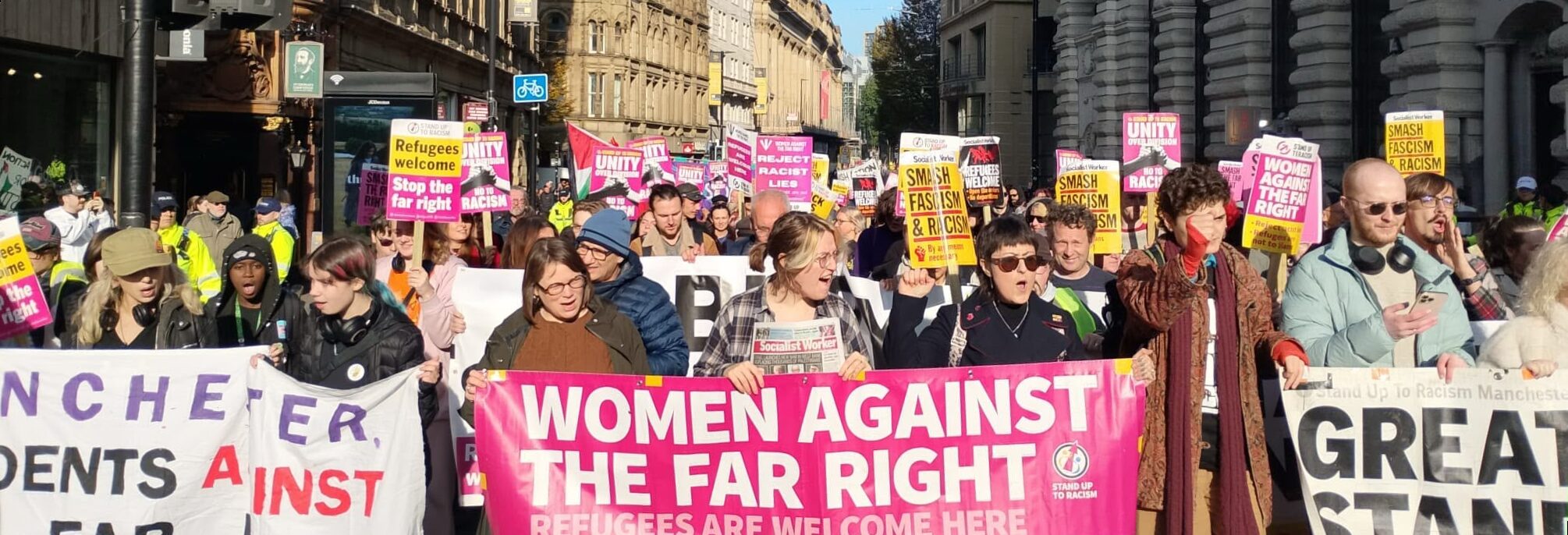
Stand Up To Racism weekly roundup | 31 October–6 November 2026
Anti-racists took to the streets in Peacehaven, Manchester and Shrewsbury last Saturday, 31 October, in another weekend of demonstrations against racism and the far right.
More than 150 marched for unity in Peacehaven, East Sussex, while hundreds mobilised against far-right groups in Manchester. In Shrewsbury, Stand Up To Racism (SUTR) supporters opposed a demonstration addressed by Britain First leader Paul Golding.
The protests came as SUTR groups continued organising further unity marches, counter-demonstrations and activities involving trade unions, community organisations and local campaigners.
Unity marches
Peacehaven: More than 150 join unity march and festival
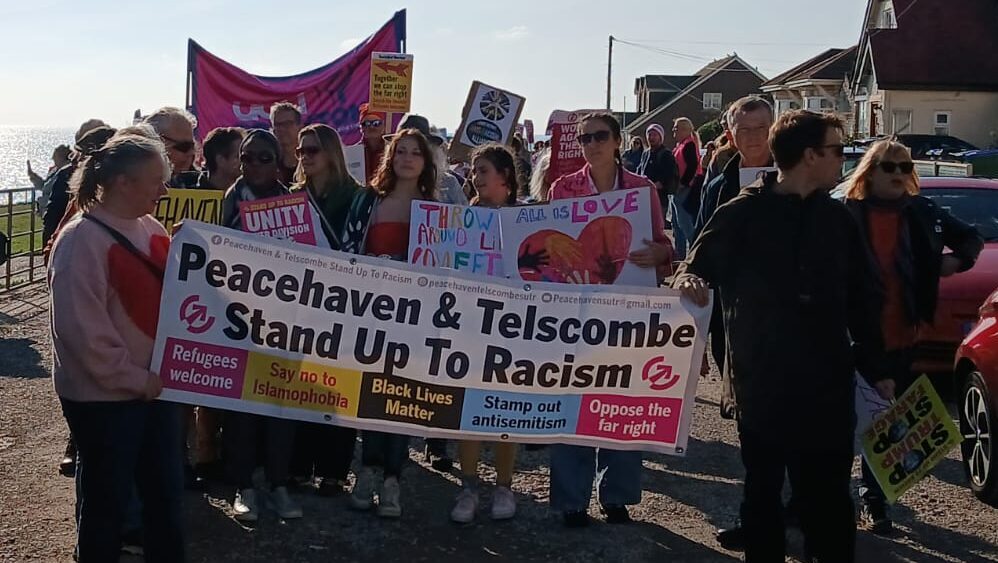
More than 150 people joined a unity march organised by Peacehaven and Telscombe SUTR on Saturday 31 October.
The march took place around a year after an arson attack on the local mosque. It brought together local residents and anti-racist activists from across Sussex, with demonstrators opposing attempts by the far right to divide local communities.
The march was followed by a unity festival at Community House, attracting additional participants. The event included live music, food, stalls, children’s activities and speeches.
Among those addressing the gathering were councillors Nikki Fabry and Paul Keene, alongside campaigners from We Are the Tree.
The march and festival were organised by the local SUTR group, which has also been supporting anti-racist activity elsewhere in Sussex, including solidarity with campaigners in Crowborough opposing weekly anti-migrant demonstrations.
Brighton and Hove SUTR reported that more people attended the festival than had joined the march. The organisation has been helping build local campaigning and fundraising activity across the area.
Counter-demonstrations
Manchester: Hundreds oppose Patriot Platform and other far-right groups
Around 400 anti-racists mobilised in central Manchester on Saturday 31 October against a far-right gathering involving members of the Patriot Platform network and right-wing social media activists.
Searchlight reported that around 60 far-right supporters attended, including approximately 20 members of Tameside Patriots led by Roman Knox.
The demonstration followed weeks of publicity by Alex Robinson, associated with Greater Manchester Patriots and Patriot Platform, who had initially threatened a march through predominantly Muslim neighbourhoods, including Rusholme, Levenshulme and Longsight.
Robinson subsequently retreated from his original plans. Searchlight reported that Robinson was in Dover on the day and that another Patriot Platform figure, Dec Lea, was in Calais.
The far-right gathering took place near No 10 North in Albert Square, where police separated protesters and counter-demonstrators.
Searchlight described anti-fascists coordinating activity in the city centre and maintaining a presence in neighbourhoods that had been threatened by the original plans.
Right-wing social media activists Billy Moore and Chris Sullivan were among those identified by Searchlight at the gathering.
A separate Quaker vigil was organised in St Peter’s Square earlier that morning by Manchester and Warrington Quakers, opposing the far-right mobilisation.
Shrewsbury: SUTR counter-protest outnumbers Britain First supporters
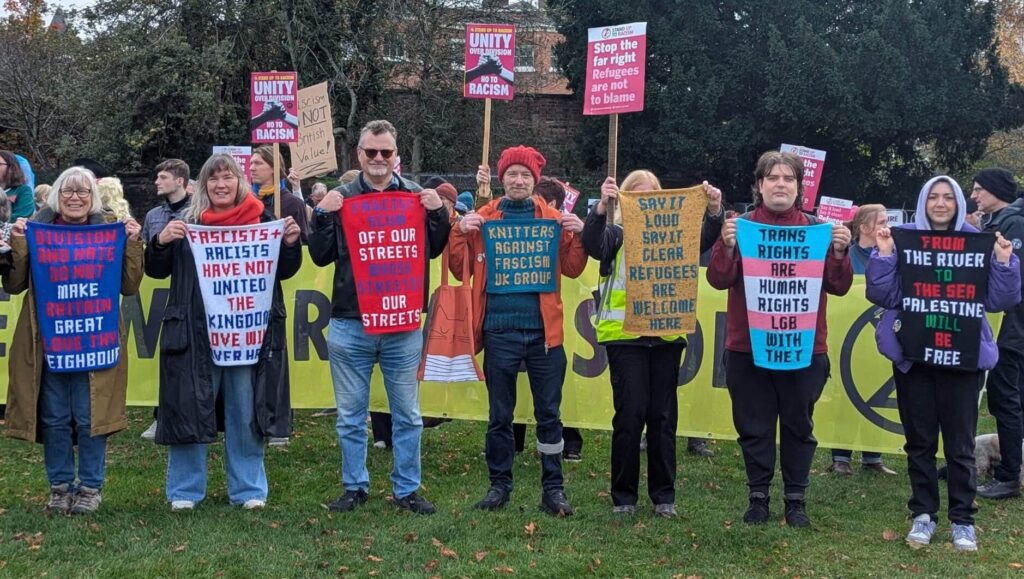
Up to 100 anti-racists gathered in Shrewsbury on Saturday 31 October to oppose a demonstration organised by Raise the Flags Shrewsbury Plus, which featured Britain First leader Paul Golding.
The far-right demonstration attracted around 70 people, according to local newspaper the Shropshire Star.
SUTR Shropshire and Telford organised the counter-demonstration in the Quarry, where the far-right group had assembled near the swimming and fitness centre.
Around 35 police officers were deployed, keeping the opposing demonstrations apart.
Anti-racists chanted against Golding as he addressed the far-right gathering. Police briefly intervened when counter-demonstrators moved closer to the group.
The far-right supporters subsequently marched through Shrewsbury town centre towards Abbey Foregate. The newspaper reported a further brief confrontation near the Market Hall.
This was the sixth Raise the Flags demonstration in Shrewsbury in recent months. Previous mobilisations have also faced opposition from local anti-racists. However this was the smallest so far.
Other anti-racist activity
Oxford: Campaign against Nathan Cofnas passes 20,000 signatures
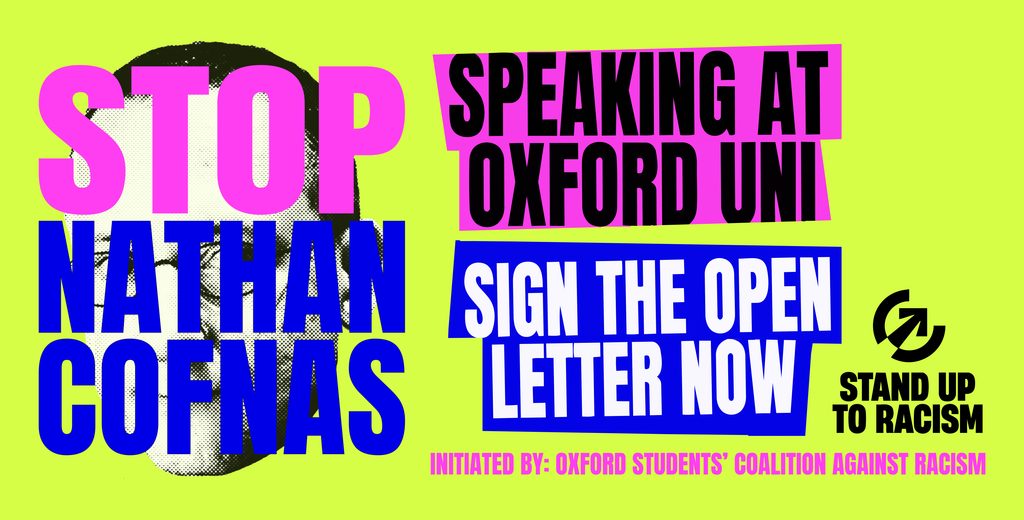
A campaign initiated by Oxford students, with support from Black Lives Matter UK, Everyday Racism and SUTR, has attracted more than 20,000 signatures opposing an invitation to Nathan Cofnas to speak at Oxford University.
The petition reached 20,000 signatures on Tuesday 3 November, according to an update published by the petition organisers.
Cofnas, who describes himself as a race realist, has argued that racial differences in intelligence have a genetic component. He has also publicly questioned the academic appointment of Professor Jason Arday.
The Oxford University Reform UK Society has invited Cofnas to speak at Oriel College on 17 November.
A statement published by SUTR on Friday 30 October called for the invitation to be withdrawn. Signatories include Diane Abbott, Bell Ribeiro-Addy, Jeremy Corbyn, Zarah Sultana and John McDonnell, alongside UCU general secretary Jo Grady, NEU general secretary Daniel Kebede, UNISON general secretary Andrea Egan and numerous writers, artists and campaigners.
Oxford SUTR has publicised leafleting stalls at Oxford Brookes University, Carfax Tower and the university science area during the week, with further campaigning scheduled for Friday 6 November.
A protest outside Oriel College is planned for Tuesday 17 November at 5pm.
London: Far-right activists target Freedom Bookshop
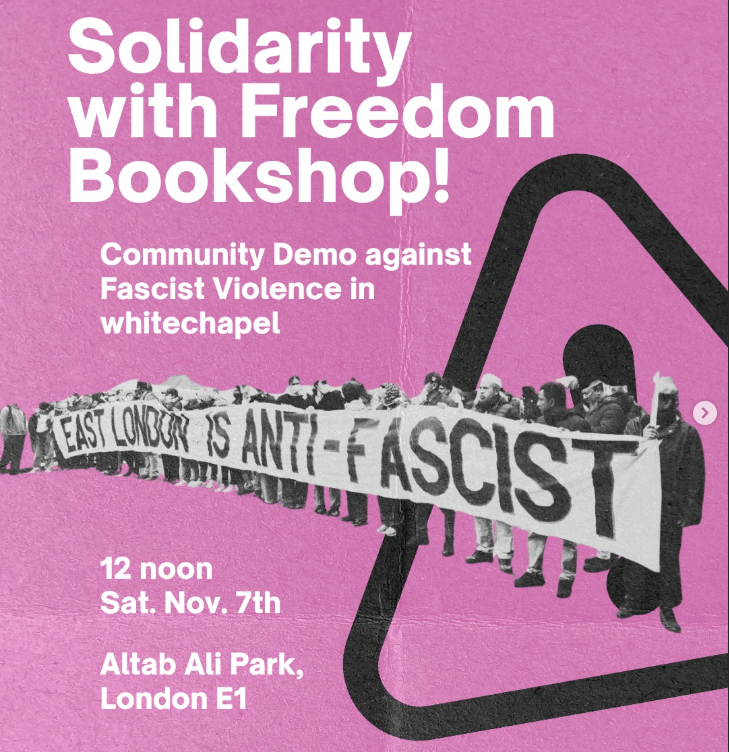
Far-right activists targeted Freedom Bookshop in Whitechapel, east London, on Saturday 31 October.
The bookshop reported that a group gathered outside the premises, intimidating staff and passers-by, and that one person was physically assaulted.
Staff secured the building, preventing damage inside, while supporters responded to calls for solidarity.
Searchlight subsequently identified those involved as members of the neo-Nazi White Vanguard group.
Building the next demonstrations
SUTR groups have continued preparations for further unity marches, counter-protests and organising events during November.
North London: A unity march on Saturday 14 November is scheduled to assemble at Wightman Road Mosque in Haringey at midday. The demonstration is part of a wider mobilisation involving local SUTR groups in Haringey and Islington, campaigning against racism, Islamophobia and antisemitism.
South London: SUTR and Love Music Hate Racism are organising a unity march from Windrush Square in Brixton at midday on Saturday 14 November. The organisers are highlighting opposition to the far right alongside justice for Professor Jason Arday and the Windrush generation.
West London: SUTR has also advertised a unity demonstration in Hayes on Saturday 14 November, beginning at 1pm.
The three London demonstrations follow the series of unity marches held across Britain throughout September and October.
Other forthcoming activities include:
- Saturday 7 November — York: SUTR counter-demonstration against a planned far-right mobilisation, beginning at midday.
- Saturday 7 November — Bristol: Together/SUTR organising summit at The Station, supported by PCS. Speakers advertised include Daniel Kebede of the NEU and Sarah Woolley of the Bakers’ Union.
- Sunday 15 November — Exeter: A community celebration of diversity organised by Exeter SUTR and Exeter Library, featuring music, activities and stalls.
- Tuesday 17 November — Oxford: Counter-demonstration against the planned appearance by Nathan Cofnas.
- Saturday 21 November — Chichester: Unity demonstration.
- Saturday 28 November — Glasgow: The STUC’s annual St Andrew’s Day march against racism and fascism.
Monitoring Group Report
Local unity and resistance are putting the far right under pressure
The growing network of local unity marches is one of the most significant developments in the anti-racist movement. From the hundreds who have marched in cities such as Sheffield, Manchester and Oxford to other demonstrations in towns such as Peacehaven, Chelmsford and Canterbury, Stand Up To Racism is helping turn opposition to the far right into visible, organised activity in local communities.
The Peacehaven march and festival last weekend showed how this can bring together residents, trade unionists and community organisations beyond the established anti-racist movement. The next round of London unity marches on 14 November offers an opportunity to extend this process. The Together mobilisations have provided a wider framework, while local activity is developing the networks and confidence needed to sustain it.
The counter-demonstrations in Manchester and Shrewsbury also revealed the gap between the far right’s online boasts and what some of its organisations can mobilise on the streets. In Manchester, Alex Robinson’s threatened march through Muslim neighbourhoods failed to materialise, while hundreds of anti-fascists confronted a much smaller far-right gathering. In Shrewsbury, anti-racists outnumbered supporters of Britain First’s Paul Golding. These were important setbacks for the far right, although individual failures should not be mistaken for a wider collapse of its influence.
The threat remains serious. Reform UK’s electoral presence, Restore Britain’s attempts to build a wider political current, and the aggressive street activity associated with Patriot Platform and Britain First represent different but overlapping challenges. Racist scapegoating over migration provides common ground between them. The intimidation of Muslim communities and attacks on anti-racist and left-wing organisations show how this politics can translate into action on the streets.
The central question is how to turn the energy of demonstrations into a broader, rooted anti-racist movement. The local unity marches point to a way of reaching people who may never previously have attended a political protest. Counter-demonstrations can challenge the far right’s attempts to dominate public spaces, while campaigns in workplaces, colleges and communities can bring wider layers into activity.
The combination of large national mobilisations, sustained local unity marches and organised opposition to far-right provocations is beginning to give the anti-racist movement greater breadth and continuity. The challenge now is to consolidate that development while confronting the racism that gives the far right room to grow.